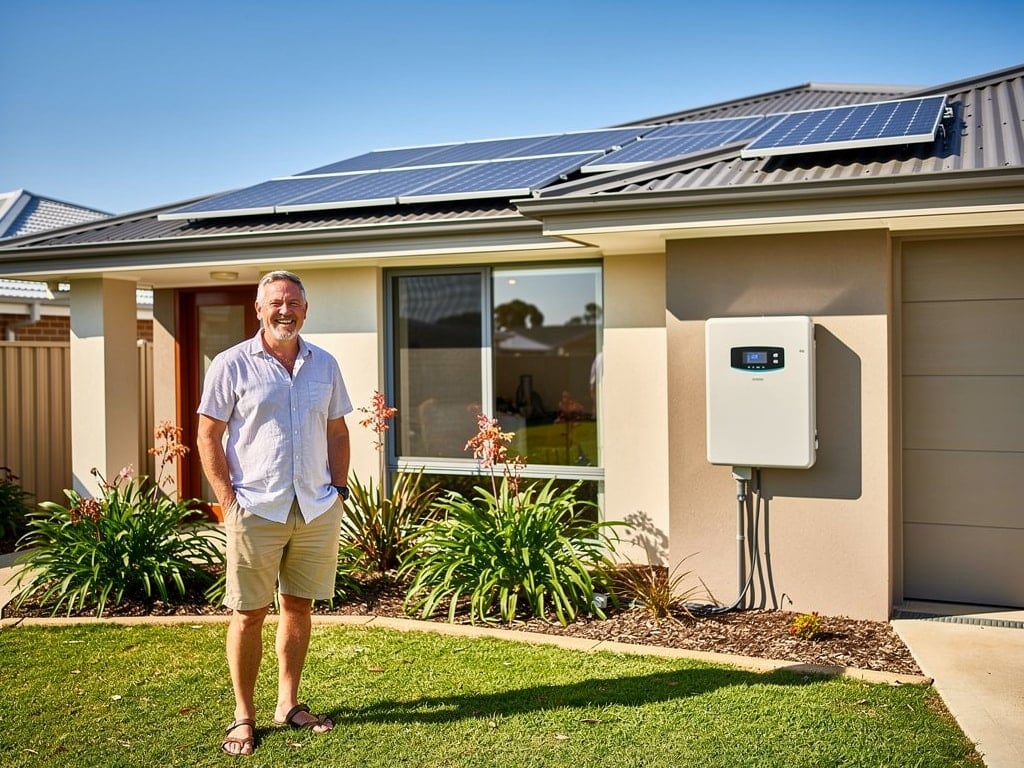

They look shiny and all-inclusive, but they often leave homeowners wondering what half the kit actually does, or whether they need it at all.
Some bundles are genuinely good value. Others bury low-tier components inside a glossy quote and bank on you not asking questions.
Here’s how to spot the difference, what to look for in a solar package, and how to claim every cent of your 2026 federal STC and Cheaper Home Batteries rebates.
What Solar Energy Packages Actually Are
A solar energy package bundles the panels, inverter, mounting frames, monitoring app, and installation into a single quote. Some bundles add a battery or EV charger.
Sold as a fuss-free way to switch to renewables, packages can save you the headache of sourcing components separately. The risk: a glossy bundle can hide low-tier hardware behind a discount-looking price.
What works for a four-bedroom place in Adelaide may be wrong for a beach shack in Cairns. Your roof angle, shade, daily kWh usage, and energy plan all change which system actually pays back.
See your 2026 rebate amount in 30 seconds.
30 secs · Free · No obligationWhat’s Inside a Solar Energy Package
Every package, glossy or honest, is built from the same six components. Knowing what each one does makes it much harder for an installer to charge you premium prices for budget gear.
Solar panels. The front liners that convert sunlight into DC electricity. Tier-1 mono panels last 25+ years; cheaper polycrystalline degrade faster and lose ~1% efficiency a year.
Inverter. Converts the panels’ DC into AC your appliances can use. Often the first component to fail, so a 10-year warranty matters.
Solar battery. Stores excess generation for night-time use. Optional, but increasingly worth it as feed-in tariffs drop.
Mounting frames. Cyclone-rated where you need them. Ask which AS/NZS standard they’re tested to.
Monitoring app. Lets you track generation, consumption, and exports. Standard now, not a premium add-on.
Installation and support. The single biggest predictor of whether your system performs. A CEC-accredited installer with local presence is non-negotiable.
Like a backyard BBQ, it’s not about how big the plate is, it’s about what’s on it and who’s behind the tongs. A cheap setup might look enticing, but when the inverter dies before summer’s out, you’ll wish you’d paid for quality.
Where Packages Help, and Where They Trap You
Solar energy packages can make life easier: one quote, one supplier, one invoice, one warranty channel. For most households, that’s the right call.
The trap is in the line items. Some bundles ship cheap panels and a generic inverter, then add charges like a “smart inverter upgrade” or “mandatory racking fee” that bring the real total much closer to a tailored quote, but with worse hardware.
Three quick checks before you sign:
1. Brand the panels and inverter. If the quote just says “premium 6.6kW system”, ask for the make and model of every component. Cross-check both against the Clean Energy Council’s approved list.
2. Compare warranty length per component. Panels should be 25 years performance, inverter 10 years minimum, workmanship 5+ years. Anything shorter is a red flag.
3. Get a separate line for the STC discount. The federal rebate should appear as a discrete line item, not vanish into a “package price”. If they won’t show it, they’re probably keeping the spread.
See exactly which 2026 rebates stack on your postcode.
30 secs · Free · No obligationWhat You Get From Going Solar
A well-sized 6.6kW system on an Australian roof typically generates 24-28 kWh per day. That covers most of an average household’s daytime use, with surplus exported to the grid for a feed-in credit.
Add a battery and the same generation runs your evenings and mornings instead of being sold back at low rates.
Lower bills. Average payback is 3-5 years for solar-only, 6-8 years with a battery. After that, the system runs effectively free for another 15-20 years.
Energy independence. Less exposure to the next round of retail price hikes.
Property value. CoreLogic data shows homes with installed solar sell faster and at a small premium in most metro markets.
Storm backup. A battery with backup-mode wiring keeps essentials running through grid outages, which are getting more frequent in storm-prone regions.
Solar Package Prices in 2026
Here’s what Aussie households are paying across common system sizes before the federal STC rebate is applied.
On a typical 6.6kW system, the federal STC rebate alone is worth around $2,500-$3,500 off the upfront price (the exact amount depends on your zone and the day’s certificate price). State schemes and the new Cheaper Home Batteries Program stack on top.
Before signing on a “half-price solar sale”, do a quick rebate check. The bundle price often already assumes the STC discount has been claimed by the installer, not passed to you.
“Stacked the federal and state rebates and our 10kW system came in $4,200 under the first quote we'd had.”
See how much the 2026 rebates can cut from your quote.
30 secs · Free · No obligationSizing the Right System for Your Home

Ignore the “Gold”, “Platinum”, and “Super Saver Deluxe” package tier names. That’s marketing. The only number that matters is your household’s actual daily kWh use.
Grab your last four electricity bills, find the average daily consumption (every Aussie bill shows it), and use this rough sizing guide:
10-15 kWh/day (small family, low daytime use): 5-6.6kW system, no battery yet
15-25 kWh/day (most households): 6.6-10kW system, battery if you’re home in evenings
25kWh+/day (large family, pool, EV, home office): 10-13kW + battery
Add a battery only if your evening usage genuinely needs it. Buying a battery for a household that’s out at work all day is like getting an eight-burner BBQ for two people. Beautiful, but you’ll never light half of it.
Should You Add a Battery?

A solar battery stores the energy your panels generate during the day and releases it when the sun’s gone. Useful if your evening usage is high, or if your retailer’s feed-in tariff has dropped below ~10c/kWh (which it has, in most states).
Typical sizing: 10-13.5 kWh covers an average family’s evening and overnight usage. Larger households or EV owners step up to 15-20 kWh.
2026 cost: $8,500-$12,500 installed for a 10-13.5 kWh battery, before the federal Cheaper Home Batteries Program rebate, which knocks roughly 30% off.
You can add it later. A battery-ready (hybrid) inverter lets you fit panels first, then add storage when the savings make sense. The federal battery rebate applies whether the battery is fitted on day one or three years later.
See your Cheaper Home Batteries Program rebate amount.
30 secs · Free · No obligationVirtual Power Plants Explained

A Virtual Power Plant (VPP) is a coordinated network of household batteries that feed energy back to the grid during peak demand. You get paid per kWh exported on top of your normal feed-in tariff.
Most major retailers now offer VPP enrolment for compatible batteries (Tesla Powerwall, Sungrow, Alpha-ESS, BYD). Typical earnings: $200-$600/year on top of bill savings, depending on your state and how often peaks fire.
If you’re already buying a battery, joining a VPP is usually free money. Just check the contract for export caps and any minimum-stay periods before you sign.
Energy Plans and Feed-In Tariffs
Once your panels are installed, the energy plan you’re on becomes one of the biggest levers for actual bill savings. Two retailers can quote the same usage rate but pay back wildly different feed-in tariffs (FiTs) for the power you export.
2026 feed-in tariff range: 4-12c/kWh depending on retailer and state. Some retailers offer time-of-export bonuses (eg 25c/kWh during 4-9pm peak) that suit households with batteries.
Action: recheck your retailer plan once a year. The plan that was best the day you installed solar is rarely the best plan a year later, and switching takes about 5 minutes.
Compare 30+ Australian energy plans against your actual usage.
5 mins · Free · Powered by Tucked2026 Government Rebates and Finance
Three rebate streams stack on a 2026 solar + battery purchase:
Federal STC rebate (Small-scale Technology Certificates). Worth roughly $2,500-$3,500 on a 6.6kW system, depending on zone. Applied as an upfront discount by your installer. Steps down 1 January every year until 2030.
Federal Cheaper Home Batteries Program. Roughly 30% off the installed cost of a 5-100 kWh battery. Steps down every 6 months.
State scheme. Varies by state: NSW Peak Demand Reduction Scheme, Solar Victoria, SA VPP rebate, etc. Worth $1,000-$2,050 on top of the federal stack in most states.
Many states also offer interest-free or low-interest finance to spread the upfront cost. A 10-minute eligibility check usually surfaces $1,000s you’d miss otherwise.
Lock in 2026 rebate rates before the next step-down.
30 secs · Free · No obligationNow check YOUR rebate stack. Takes 30 seconds.
Federal STC + state top-ups where available for your postcode and system size. Free, no obligation, no spam. If you don't qualify, we tell you immediately so you stop wondering.
The Bottom Line
Solar energy packages can be a smart way to go solar, or an expensive shortcut around due diligence. The difference is in the components, the installer, and how much of the rebate stack you actually claim.
You don’t need to overspend. You do need a brand-named quote, a CEC-accredited installer with local presence, and a clear view of which 2026 incentives apply to your postcode.
Solar Incentives matches you with vetted installers and confirms every cent of federal and state rebate you’re entitled to, before you sign anything.
Waiting until 1 Jan 2027 costs around $1,000. The STC scheme deems one fewer year of certificates every January, and the Cheaper Home Batteries rebate steps down every 6 months.
Start your free 30-second 2026 rebate check.
30 secs · Free · No obligationFrequently asked questions

Jerome Trimboli
Jerome has over 2 years of experience in the renewable energy sector. Australian born and raised, he takes pride in advancing sustainable energy solutions to benefit both the environment and local communities. In his spare time, Jerome enjoys watching Aussie rules, cricket, soccer and basketball, as well as travelling across the world to parts unknown.